
Overview
Somewhere under your Jeep is a rear axle with an expiration date on it. Nobody stamped it there. You find out where it is about four feet past the point where backing off was still an option.
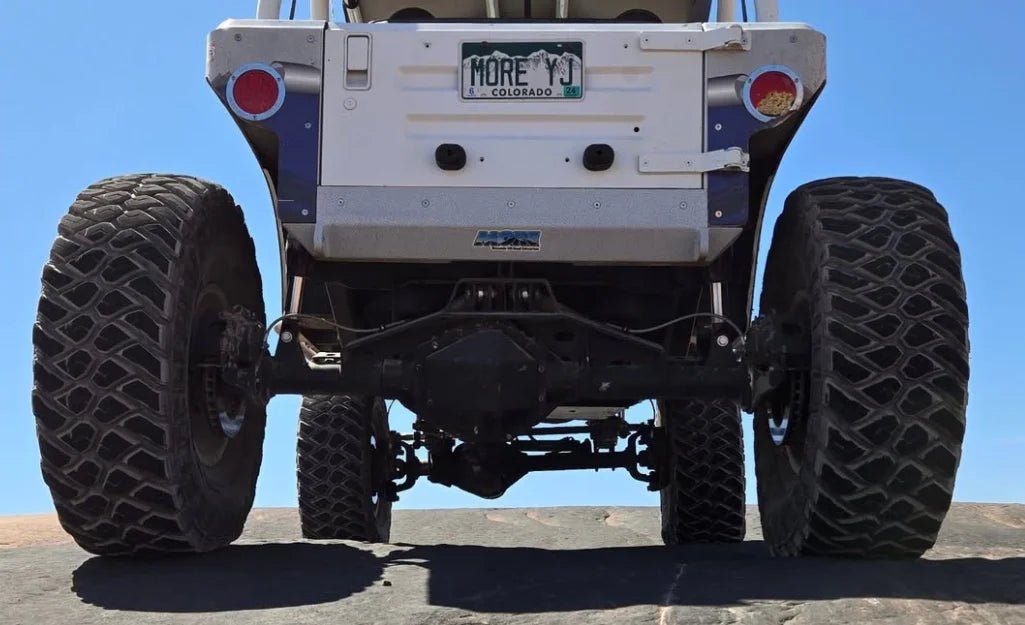
That's the real reason anyone prices a Jeep Ford 8.8 swap. Not because Ford built a prettier axle, but because a junkyard Explorer housing costs less than a decent pair of shocks and shrugs off loads that fold a Dana 35 in half.
Table of Contents
- How Big Is Too Big For A Dana 35?
- Is The Swap Worth It In 2026?
- Which Explorer Year Do You Need?
- What To Inspect Before You Pay
- Can You Swap Without Welding?
- Building From Individual Brackets
- The Build In Three Steps
- ABS, Width, Cables And Yokes
- Myth Vs Truth
- Fitment And Budget
Part 1 – Should You Do A Dana 35 To Ford 8.8 Swap At All?
#1 – How Big Is Too Big For A Dana 35, And How Much Stronger Is A Ford 8.8?
Ask ten people where the Dana 35 gives up and you'll get ten answers, all delivered with total confidence. Honest version: an open 35 on 33s, driven with some restraint, lives for years. Add a locker and it snaps shafts on 32s, because now both wheels pull and nobody slips out of trouble.
So how much axle are you buying? Search it and you'll find the same claim everywhere — that the Ford 8.8 is 120 percent stronger than the Dana 35. It's the number that convinces people to spend the money, and it doesn't survive contact with a tape measure. The ring gear grows from 7.562 inches to 8.8. The shafts go from roughly 1.18 inches and 27 splines to 1.32 and 31. Warn once ran both on a torque rig and stopped the Dana 35 at 3,480 lb-ft against 5,100 for the 31-spline 8.8. That's about 47 percent, not 120.

Still the gap between limping home and paying for a rollback. The Pirate4x4 thread where those figures get argued over has the raw numbers, including the Dana 44 giving up around 4,460 in the same test. The junkyard Ford outlasted the axle everyone saves for.
#2 – Is The Ford 8.8 Swap Still Worth It In 2026?
Ford built the Explorer north of 400,000 units some years, which is why a Ford explorer 8.8 rear end swap became the default instead of a boutique project — year-by-year Explorer production figures show the scale.
Then 2009 happened. Cash for Clunkers paid Americans to trade older vehicles toward something efficient, and each trade-in had to be crushed. Scrapyards could sell body and interior parts first, but federal rules barred them from reselling the engine or the drive train. Your rear axle is drive train. The most traded-in vehicle in the program was the four-wheel-drive Ford Explorer, and the four most surrendered model years were 1998, 1997, 1996 and 1999 — exactly the window that makes the best donor. Jalopnik's breakdown of the trade-in data has the ranking.
Still the best strength per dollar in the Jeep world, but tripping over three in one yard is history.
Part 2 – Buying The Right Axle: Ford 8.8 Axle Swap Years And Junkyard Tactics
#3 – What Year Of Explorer Does The 8.8 Come Out Of?
Every Explorer from 1991 to 2001 has a solid-axle 8.8 under it. Only 1995 to 2001 is worth your Saturday.
Those years came with 31-spline shafts instead of 28, and factory rear discs, so you inherit an upgrade most people pay for separately. The bolt pattern is 5 on 4.5 inches, which your TJ, YJ and XJ already run. Mercury Mountaineers count too, and half the yard staff in America doesn't know it. The 1991 to 1994 axles are drum-braked and often 28-spline, so for the same fifty dollars, find the good one. Car-Part.com's Interchange search expands one search across every vehicle sharing a part, which is how you find Mountaineers hiding behind Explorer listings.

#4 – What To Inspect On A Junkyard 8.8 Before Buying, Including What Gears Do I Need For A Ford 8.8 Swap
Bring a crayon and a flashlight. Twenty minutes here saves a month later.
Unscrew the vent fitting on the passenger-side tube and look down the hole. Some walls are a quarter inch, some 0.188 — you want the thick one. Rock the pinion flange; play you can feel by hand is a bearing. Spin each wheel and listen for a whine that rises and falls. Check the seam where each tube enters the cast center for hairline cracks. That's the 8.8's known weak spot, and a cracked one isn't worth taking home.
Then the gear ratio, which has to match your front axle exactly or your transfer case eats itself. The tag reads in codes: D4 is 3.73 with limited slip, D2 is 4.10. No tag? Mark the driveshaft, spin one wheel a full turn, count the rotations. Most Explorers left with 3.73, fine for 31s behind a 4.0L. On 33s most people land on 4.56, on 35s 4.88 — and if your front is already 4.10, a Ford 8.8 4.10 gear kit beats regearing both ends.

Part 3 – Ford 8.8 Jeep Conversion Kits Or Build It Yourself From Brackets
#5 – Can You Do A Ford 8.8 Swap Without Welding? What A Ford 8.8 Swap Kit Includes
Short answer: no. Longer answer: no, but it doesn't have to be your welding.
The Explorer's spring perches sit in the wrong place for a Jeep. They come off, Jeep-correct brackets go on, and that means an arc. What changes is who strikes it. Plenty of people clamp everything in place and hand it to a shop for an afternoon, or buy a complete bolt-in axle and skip fabrication. That's the honest measure of Ford 8.8 swap difficulty — not skill, just budget and whether you know somebody with a welder.
The kits to convert Ford 8.8 axle for Jeep Wrangler cover everything the arc doesn't. Leaf-sprung rigs also want our U-bolts for the 8.8 and Dana 60, matching U-bolt plates, and weld-on leaf spring mounts in the radius that suits your housing. Buy a Ford 8.8 u bolt kit worth of hardware once and you won't be re-torquing mystery bolts from a coffee can in six months.
#6 – Building Your Own Axle Setup From Individual Brackets
Here's the part most guides skip: you don't have to buy a whole kit.
If half your brackets came off a previous project, every piece of our Ford 8.8 TJ bracket kit sells on its own — lower control arm brackets, upper control arm bracket, coil buckets, coil retainers, shock mounts, track bar bracket and sway bar brackets. Buy the four you're missing instead of the eleven you're not. A complete Jeep TJ Ford 8.8 swap kit still wins if you need everything.
Leaf-sprung builds get one more trick. An axle offset plate shifts the housing three-quarters of an inch or a full inch fore or aft without recutting perches — useful when the new axle lands a fraction off. Order axle offset plates in the width matching your springs and re-drill the U-bolt plate.

Part 4 – The Build, Step By Step
#7 – Step 1: Measure, Then Strip The Donor
You'll need a welder that handles quarter-inch steel, a grinder, a digital angle finder, and a torque wrench.
Your old axle is a template, and once it's on the floor that information is gone. At ride height on its own weight, put the angle finder on the rear driveshaft, then on the flat machined face of the pinion yoke. The difference is your working driveline angle, and you'll reproduce it at the end. Measure from each axle tube to a fixed point on the frame, both sides, and photograph everything before a bolt moves.
Then every Ford bracket comes off. Cut the perches, shock mounts and leftover tabs, then grind the tubes back to bare steel where new brackets will land. Paint and weld have never gotten along.
Open it on the bench while it's easy. Pull the cover, drop the shafts, look hard at the ring and pinion — chipped teeth or a polished wear pattern on one side means abuse. Check the shafts where they neck down near the splines, because that's where a tired one fails. A twenty-five-year-old axle has twenty-five-year-old bearings, and a Ford 8.8 rebuild kit costs a fraction of pulling everything back out next season. If the gears look tired too, a full Ford 8.8 axle rebuild kit is the cheaper afternoon. Regearing? Do it now on the bench, and match the front while you're spending money.
#8 – Step 2: Weld The Tubes, Then The Brackets
Order matters more than technique. Tubes first, brackets second, never the reverse.
The 8.8's steel tubes are pressed into a cast center section and held there by friction and optimism. Wheel it hard enough and a tube rotates in the casting, sending your carefully placed perches somewhere creative. So weld them — short stitch welds at each joint, alternating sides so heat doesn't pull anything crooked. Lincoln Electric's guidance on welding cast iron covers preheat, nickel electrodes, and the rule people break most: pick the hot method or the cool method and don't switch halfway. Planning on 37s? A Ford 8.8 truss kit over the top is cheap compared to a bent housing.
Brackets next. Your kit instructions carry the exact placement dimensions — use those, not a photo from a forum. Set the housing centered side to side within about an eighth of an inch, referenced off the frame rather than where the old axle happened to sit.
Then tack everything and stop. Roll the axle under, bolt up the arms or drop the springs on, and confirm it lines up before you commit. Tacks grind off in five minutes. Run short passes and move around the housing — heat warps tube, and warped tube is a bent axle you paid to create.
#9 – Step 3: Pinion Angle, Brakes, And Shakedown
Get the Jeep back on its wheels at ride height first — suspension geometry lies to you when the axle hangs on jack stands.
Install the driveshaft, then set the pinion angle, in that order. One to two degrees nose-down on a coil rig with adjustable arms, two to three on leaf springs. Anyone researching Ford 8.8 XJ swap pinion angle sye learned that sequence the expensive way.
Brakes next. Run your hard lines, add a stainless rear brake line while you're under there, fit the cables, then bleed from the corner furthest from the master cylinder inward. A brake line kit for Ford 8.8 swap is a ten-dollar problem that becomes a hundred-dollar one. If the rear locks early, that's proportioning.
Then the shakedown. Notice what speed vibration appears at: a shake arriving around 45 and worsening is usually driveline angle, one that shows at highway speed and stays is usually balance. Re-torque every bracket bolt after fifty miles, recalibrate the speedometer, and crawl under it once more before you hit rocks.

Part 5 – The Gotchas Nobody Warns You About
#10 – ABS, Width, Cables And Yokes
Deal with the ABS fear first. Your Jeep's module won't read the Ford tone ring, so most people disconnect it and live with a dash light. What nobody mentions is that you just traded rear drums for factory discs — the thing people happily pay for as a Ford 8.8 disc brake conversion kit. Your Jeep stops better than it did yesterday.
Width goes the other way from what everyone expects. The 8.8 is narrower than your Dana 35, about an inch and a quarter overall, so tires tuck in and your turning radius improves. On stock wheels with deep backspacing, our lug-centric wheel spacers in the 5 on 4.5 pattern sort it, with the matching lug nuts to suit. Most people run none.
Then the two parts discovered at 11pm with the axle bolted in. Ford routed the parking brake cables for a Ford, so yours won't reach — a Ford 8.8 parking brake kit solves it, which is why Ford 8.8 swap e brake cable adapters exist. And the Explorer's metric four-bolt flange has never met a Jeep yoke, so our 1310-series yoke adaptor bolts to the Ford flange and your existing driveshaft goes straight on.
Part 6 – Myth Vs Truth, Fitment, And Cost
#11 – Are C-Clip Eliminators A Gimmick?
Yes, the 8.8 is a C-clip axle. No, that isn't the dealbreaker forums make it out to be.
The shaft breaks, not the clip. And with rear discs, a snapped shaft stays put instead of leaving the housing with your wheel attached. Stock 31-spline shafts handle 35s comfortably and plenty of people run 37s. Past that, chromoly starts earning its price.
Where a Ford 8.8 c clip eliminator kit earns its money is retention and trailside repair, since you can swap a shaft without pulling the cover in the dirt. NHRA's rulebook is the useful outside check: drag racing requires eliminators at 10.99 or quicker, or on any car running a locker or spool. Note that second condition. That's the one that applies to you.
#12 – Fitment And Budget: TJ, LJ, YJ, XJ
TJ and LJ owners share one kit — our Ford 8.8 swap kit for the 1997 to 2006 TJ and 2004 to 2006 LJ, with the matching TJ emergency brake cable. Leaf-sprung builders doing a Ford 8.8 YJ swap want the YJ kit for 1987 to 1995 and the YJ e-brake cable. For a Jeep Cherokee Ford 8.8 swap, our XJ kit covers 1984 to 2001 with XJ e-brake cables in early and late fitments. Searching Jeep ZJ Ford 8.8 swap? The Grand Cherokee's rear needs different geometry than anything here, so confirm fitment before buying a donor.
Money. A donor axle runs fifty to three hundred dollars, brackets add a hundred and fifty to three hundred, gears and install another five to eight hundred. A careful DIY build lands near fifteen hundred; doing it properly with a selectable locker, fresh gears and new brakes puts you at twenty-four hundred to three thousand — the honest answer to XJ Ford 8.8 swap cost on any platform. Build your Ford 8.8 TJ swap parts list before you buy the axle, because the axle is the cheap part. A first-timer with a welder and no surprises is looking at two solid weekends.

Final Thoughts
The Dana 35 isn't a bad axle. It's an honest one, designed for a lighter Jeep on smaller tires. You're just not asking it to do that job anymore.
Do this once. Right donor year, welded tubes, matched gears, correct pinion angle — and you'll never think about your rear axle again. Our Ford 8.8 kit for sale pages list what's included, and every bracket is built in Colorado, because our American made Jeep parts are made by people who already made these mistakes so you don't have to.

Leave a comment
This site is protected by hCaptcha and the hCaptcha Privacy Policy and Terms of Service apply.