
Overview
You know the sound. That flat, hollow bang from under the floor that travels up through your boots and into your teeth. Everybody in the cab goes quiet. You keep rolling, then spend twenty minutes doing math about what you just hit and what it'll cost.
That sound is why off road skid plates exist.
And this is the full breakdown. What a skid plate actually is, what's hiding under your rig, what each part costs when it breaks, and what to buy first. Who needs one? And on steel versus aluminum, who's right? By the end you'll know enough to walk under your own truck with a flashlight and make the call yourself.
Table of Contents
- What Does A Skid Plate Do? What Parts Do Skid Plates Protect?
- Do You Need A Skid Plate, Or Can You Drive Without A Skid Plate?
- Do I Need Skid Plates For Overlanding, Or Only For Rock Crawling?
- Are Stock Skid Plates Enough?
- Best Material For Skid Plates For How You Actually Drive
- Which Skid Plate Do I Need First?
- The Myths: Weight, Rust, And Heat

What Does A Skid Plate Do?
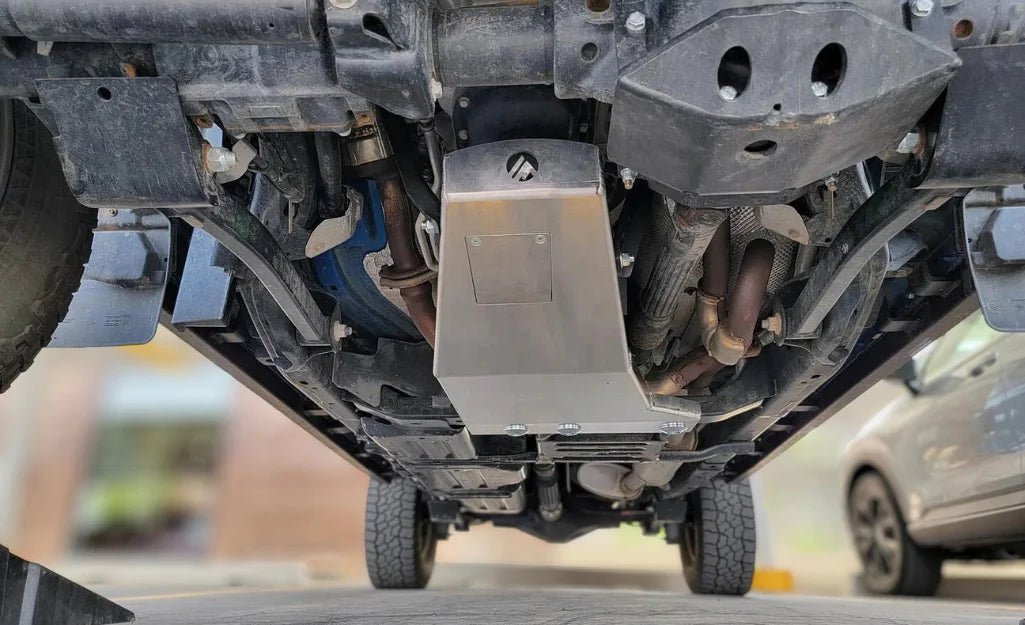
It's a flat piece of plate metal bolted across the bottom of your rig, between an expensive component and the ground. The magic is in thickness, shape, and where it ties in.
A skid plate has two jobs, and most people only think about the first one.
Job one is taking the hit. When your rig lands on a rock the size of a grapefruit, all that weight arrives on a contact patch the size of your palm. Pressure is force divided by area, so when area shrinks the number gets ugly fast. A proper plate carries that load out to the frame rails instead of letting it punch up into your oil pan.
Job two saves your afternoon. A good plate lets you slide. Hang up with your belly on granite and you're not damaged, just stuck, which is a much longer day than it sounds.
Now the confusion that sends people down a rabbit hole. That black tray under your engine is not armor. Ask five people what is the plastic under the car called and you'll get five answers, and searching what is the cover under the car called or plate under car turns up the same mess: splash shield, air dam, undertray, belly pan. It's usually ABS plastic on clips and 10mm bolts, and its job is aerodynamics and keeping spray off your alternator. An under engine cover like that folds around a rock without slowing it down. A real engine skid plate is steel or aluminum plate, usually 3/16 inch or thicker, bolted to structure. See the difference across our skid plates collection.
One practical note while you're under there. If you've got a metal piece hanging under car or a torn tray dragging, deal with it now. People ask how long can you drive with a dragging splash shield and the honest answer is: to the next parking lot, slowly. A loose panel catches pavement, wedges under a tire, or rips out wiring on its way off. Zip-tie it or pull it, then replace it with a real undercarriage shield.

Do You Need A Skid Plate, Or Can You Drive Without A Skid Plate?
Straight answer. can you drive without a skid plate? Yes. Millions do it daily and never think about it.
But… The moment you're on gravel, forest roads, ruts, or anything with rock in it, the answer flips. Kelley Blue Book lays out the same cost-benefit logic in their buyer's guide on whether skid plates are worth the money. Here's the part people miss: a truck skid plate isn't only for dramatic crashes. Most underbody damage happens at low speed, on easy terrain, from something nobody saw.
So are skid plates worth it? A single plate typically runs a couple hundred dollars. An oil pan replacement is commonly several hundred to well over a thousand once labor is counted, and if you lose oil pressure before you notice, you're into engine money.
So are skid plates necessary? Not for everybody. For you, probably.
Are Stock Skid Plates Enough?
Depends on the trim, and you should look rather than assume. Many factory skid guards are stamped steel around 1/8 inch, and on plenty of non-off-road trims the transmission and fuel tank get plastic or nothing.
Factory plates aren't fake. They're engineered to a weight and cost target for gravel spray and shallow ruts, and they pass that test. But they flex under frame twist, which is exactly when a thin plate stops spreading load and starts acting like a wedge pointed at what it covers.
Mounting matters as much as metal. Toyota published a service document covering 2014 to 2020 Tundras where the TRD plate creaked against the frame crossmember, and the official fix was correct bolt torque, not shims — see that technical service bulletin filed with the NHTSA.
So are stock skid plates enough? For a graded forest road, sure. Once you're seeing dents, or a plate pushed against the part it protects, you've outgrown the skid guards that came free with the truck.
Here's your inspection. Get under with a light. Scratches are fine, that's the plate working. Look for deformation instead: a plate pushed upward, an elongated bolt hole, a bent mount. If a plate is touching what it protects, it has already failed. A factory 4runner trd skid plate covers real ground, but it stops where engineers decided the average buyer stops.
Do I Need Skid Plates For Overlanding, Or Only For Rock Crawling?
Both, for different reasons.
Crawlers expect impact and armor accordingly. Overlanders run loaded heavy over long distances, and their risk isn't a boulder garden. It's one buried rock on mile forty of washboard, with 500 pounds of gear pushing the belly lower than stock. More weight means less clearance and harder landings.
So do i need skid plates for overlanding has a real answer, and it's about consequence, not difficulty. A cracked pan with your buddies around is a story. Alone, out of cell service, it's a rescue. We broke down how priorities shift in our guide to overlanding versus off-roading versus rock crawling.
We mapped out how these styles differ in our guide to overlanding versus off-roading versus rock crawling, worth reading before you spend a dollar, because build priorities change depending on which one you are.
You're Not The Only One Asking This
So are skid plates worth it? If you've wondered whether you're overthinking this, go look at what off-roaders argue about in the Jeep Wrangler forum thread comparing aluminum and steel skid plates. It's been running for years.

The Parts You Forget Until They Break
What Parts Do Skid Plates Protect?
Oil pan first. Lowest and furthest forward, so it's usually the first casualty. Punch a hole and you don't have a leak, you have a countdown measured in minutes. Replacement is commonly several hundred dollars, more when the subframe comes out, and vastly more if the engine ran dry. That oil pan cover under car is why engines survive mistakes.
Transmission next. On several newer platforms the pan is molded plastic weighing about a pound, with zero factory protection. When people ask do i need a transmission skid plate, go look at your pan. Plastic means yes, immediately. The pan is cheap; the rebuild after losing all your fluid on a trail is not.
Transfer case sits right where you drag on ledges, and it's one of the priciest drivetrain repairs on the list, comfortably four figures with parts and labor.
Then the fuel tank. Ask do i need a gas tank skid plate and half the answers come from people who found out plenty of trims ship a thin shield back there, or nothing. A punctured tank isn't a repair, it's a tow, and a fire risk on the way. Differentials, steering box and exhaust are secondary, but a cracked diff cover dumps gear oil the same way.
Which Skid Plate Do I Need First?
Buy in this order and you never waste money.
Engine and transmission come first, together, because those failures end the day immediately and cost the most. A front skid plate covering the oil pan is the highest-value piece of armor on the vehicle. Fuel tank second, since your back half drags more than people expect on descents and steep exits, which is where a rear skid plate earns its money. Transfer case third, especially if your weekends include shelves and steps. Steering box last, unless you run oversized tires.
If budget is tight, one good plate on the engine beats a cheap full set. Coverage is laid out by vehicle in our skid plates collection, so you can add pieces over time.

Aluminum Vs Steel Skid Plates: Which Should You Get?
Best Material For Skid Plates For How You Actually Drive
Steel takes sharp point-loads better than anything else at a sensible price. It bends instead of cracking, and a bent steel plate can be hammered flat or welded on a Tuesday night. It slides across rock rather than biting in. The costs are weight, and rust if you neglect it.
Aluminum is meaningfully lighter and won't corrode the same way. It costs more, and to match steel's protection it has to be noticeably thicker, which eats into the weight advantage.
The rule: if your trails have rock in them, steel is the right default. If you're a weight-limited build on dirt roads and long highway transfers, aluminum makes sense.
The Expedition Portal thread on aluminum versus steel shows how overlanders weigh this differently than crawlers do. That's the real answer to best material for skid plates. There isn't one. There's only what matches how you drive and whether your state salts the roads.
How Thick Should A Skid Plate Be?
Factory plates are commonly around 1/8 inch. Serious aftermarket steel is typically 3/16 inch, with 1/4 inch on high-abuse pieces. Aluminum needs roughly 1/4 inch to do what 3/16 steel does, because it's softer.
Which brings up how much do skid plates weigh. A single front steel plate usually lands around 25 to 45 pounds. A full steel belly setup on a Wrangler-sized rig can run past 150 pounds. Aluminum cuts that close to half.
Thickness alone doesn't decide anything, though. A flat plate bends in the middle; one with formed ribs, folded edges, or crossmember tie-ins stays flat under the same hit. That's why two 3/16 plates can perform completely differently.
The Myths: Weight, Rust, And Heat
Do Skid Plates Hurt Gas Mileage Or Trap Heat?
Back in 2009 a Subaru owner got tired of guessing and ran a test. He put a temperature sensor in the engine bay, drove a week logging max temps, then fabricated a panel over the opening where a skid plate mounts and repeated it.
Temps rose about 12 to 15 degrees Fahrenheit at low and moderate speeds, with no real difference at highway speed. He was upfront that his homemade panel wasn't shaped like a production plate, but the takeaway holds: engine bay air exits at the bottom, and covering some of it costs very little. His write-up on the Subaru Outback forum has the method.
On fuel economy, the working rule is roughly one percent per hundred pounds. A car undercarriage cover in plate steel isn't killing your mileage. Your tires, your lift and your right foot are.
Do Skid Plates Cause Rust?
Plates trap mud, and mud holds salt and moisture against your frame. If your roads get salted, that's not a myth, it's a maintenance schedule. Three things fix it: drainage designed into the plate, a coating that doesn't chip off in the first season, and pressure-washing the underside after muddy or salted runs.
There's also galvanic corrosion, which just means two dissimilar metals touching with water present start a slow reaction. Aluminum bolted to a steel frame corrodes first. Isolation washers and intact coatings handle it.
Plates don't cause rust. Neglected plates do.
What Makes Made In USA Skid Plates From Mountain Offroad Different
We've been building parts in Colorado since 1978, starting in a home garage, and we still wheel the same trails our customers do.
Built And Tested Where You Wheel
Many off-road parts for overlanders and offroaders made overseas use lower-grade steel or aluminum to cut costs. The result? Weaker Jeep body armor that bends under pressure, bumpers for Jeep Gladiator that crack on impact, and rock crawling vehicle modifications that fail when you need them most. With USA-made parts, precision manufacturing ensures tight tolerances, perfect alignment, and a hassle-free install.
Every Mountain Offroad piece is designed in-house with 3D CAD, laser cut, and welded by certified welders. That's why bolt holes line up on the first try instead of you elongating slots with a die grinder at eleven at night.
Our skid plates carry the RockProof™ Lifetime Warranty, with full terms on our warranty and return policy page. For the longer story on domestic manufacturing, our breakdown of why American-made off-road parts matter covers what "assembled in USA" quietly means.
Sure, cheaper alternatives might save you money upfront, but the long-term costs of failure can quickly add up. If a Toyota 4Runner skid plate bends too easily or a Jeep parts with quality control issue causes premature wear, you’re not just replacing a part—you’re dealing with potential vehicle damage, additional labor costs, and lost trail time.
High-quality materials and expert craftsmanship mean durable off-road parts last longer. Instead of swapping out parts every season, USA-made components are designed to handle years of abuse.
And knowing that your off-road performance and durability upgrades won’t fail when you’re miles from civilization? That’s worth every penny.
Off-roading isn’t just about the thrill — it’s about trust in your gear. The last thing you need is a part failing when you’re deep in the backcountry.

Best Off-Road Skid Plates For Your Jeep, Toyota, Or Gladiator
Generations matter more than people expect. Mounting points move, exhaust routing changes, and a Jeep wrangler JK skid plate is not a JL part.
On the Jeep side we cover a wide range, from a Jeep YJ skid plate and Jeep wrangler TJ skid plate through Jeep JK skid plates, JKu skid plates, Jeep JL skid plates and Jeep Gladiator skid plates, including the Jeep Gladiator front skid plate. It all and more lives in our Jeep collection.
Toyota is the same story. Whether you need a Toyota 4runner skid plate to replace a tired factory piece, Toyota tacoma skid plates, or Toyota tundra skid plates, start in our Toyota collection. There's a growing lineup in our Ford collection too.

Final Thoughts
Nobody buys armor because it's fun. You buy it because the alternative is standing on a trail at dusk watching fluid pool under your rig.
When people ask how much do skid plates cost, the useful comparison isn't against zero. It's against one tow, one pan, and one weekend you don't get back.
Browse the full skid plates collection to see what fits your rig, check our current best deals if you're building on a budget, and if you'd rather spread the cost, Buy Now Pay Later through Shop Pay splits it into installments with no late fees.
The trail will find your weak spot eventually. Might as well pick which one it hits.

Leave a comment
This site is protected by hCaptcha and the hCaptcha Privacy Policy and Terms of Service apply.