

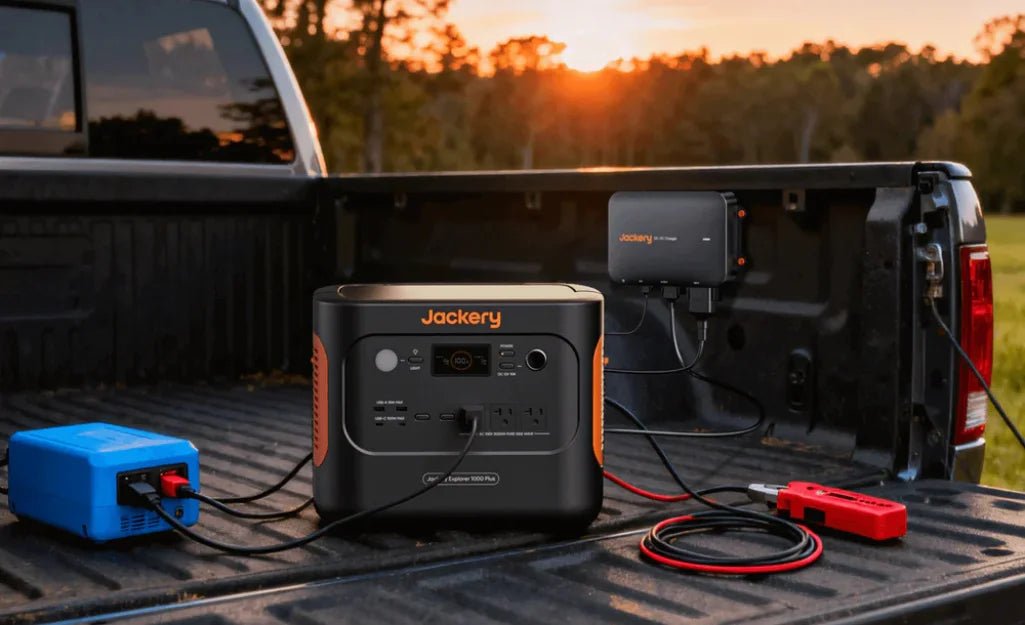
Overview
Portable power gets easier when you size it to how you actually use your rig — whether you’re crawling trails for a day, running a weekend camp spot, or living out of the back for longer trips. We’ll turn those real inputs into a few clear checks you can use anywhere, so you’re carrying only what earns its place in your portable power setup.
By the end, you’ll know how to pick a right-sized system without getting lost in numbers: a quick watts vs watt-hours reality check, a simple 3-device test to catch underpowered builds, and the drain traps that quietly kill a weekend. We’ll also cover what portable solar panels can do in real conditions (not perfect sun), plus the cable basics that stop a flaky camping charger from derailing your whole system.
We’re glad to welcome Jackery as a Mountain Offroad brand partner—check out what we carry in our Jackery partner collection.
But if you’re not sure what you need yet, this post is for you.
Table of Contents
- The 60-second reality check: watts vs watt-hours (so you stop guessing)
- The “3 device test” that instantly tells you if you’re underpowered
- The “invisible drain” problem: fridges, radios, lights, compressors, chargers
- Solar reality check: what panels can do in real conditions, not perfect conditions
- The cable & connector basics that prevent 90% of field issues
The 60-second Reality Check: Watts vs Watt-hours (So You Stop Guessing)
Why Watts vs Watt-hours Decides Your Portable Power
Here’s the clean way to think about it: watts are how hard you’re pushing right now… watt-hours are how long you can keep pushing.
→ Watts are the speed on the speedometer.
→ Watt-hours are the size of the fuel tank.
That’s why people end up frustrated with a best camping power bank that looked “strong enough” on paper — because it had decent output (watts), but not enough stored energy to last the night. And it’s why a rig can feel “covered” with a small back up battery for phones, then still fail when you add real loads like a fridge, lights, and charging gear. When you’re planning a power outage backup at home, it’s the same story: the question isn’t “can it run this?”... it’s “how long, and at what cost?”
If you want a mental shortcut, remember this: watts keep things from tripping… watt-hours keep your weekend from ending early. That applies whether you’re picking a portable electric generator for camping, a camping generator, or even evaluating a clean energy generator setup for quieter camp life.
Quick Sizing Shortcut for a Portable Small Power Station
Don’t start with the product—start with the night. Picture your typical evening and morning: what runs continuously, what runs occasionally, and what’s a “nice to have.” Your continuous stuff is the trap, especially charging. A portable charger for camping looks harmless… until it’s topping off multiple devices, all weekend, while you’re also running lights and a fridge.
Here’s the rule that saves people: if your setup has to feel effortless, size it so you’re using only part of your capacity, not all of it. That’s the difference between a calm camp and babysitting a camping battery pack like it’s a ticking clock. And once you know your baseline, adding solar electricity for camping later becomes a bonus — not a requirement for survival.
Do this quick: write your devices, then calculate daily energy as Wh = watts × hours.Add 20% buffer for real life. If you land around 1,000–1,500Wh/day (phone, lights, basic charging + a small fridge), a 1kWh-class unit like Jackery Explorer 1000 or Solar Generator 1000 Plus usually makes sense. If you’re closer to 1,800–2,500Wh/day (fridge + more lighting + heavier charging), that’s where Solar Generator 2000 Plus starts feeling “easy.” And if you’re thinking home-style backup loads, you’re in bigger-capacity territory like HomePower 3600 Plus or Jackery Explorer 5000 Plus — because watt-hours decide runtime.

The “3 Device Test” That Instantly Tells You If You’re Underpowered
The Test For Best Portable Power Station For Camping
The 3 Device Test is just a fast way to match the right size to your real trip. Pick the three things you’ll most often run at the same time (usually a fridge, lights, and charging) then run them together for a few minutes. If everything stays steady, you’ve found a setup that fits your routine. If it feels tight, it simply means you’re asking more than that size was designed to deliver, and you’ll be happier stepping up.
When You Actually Need An Expandable Power Station
Expansion makes sense when your trips get longer or your loads get “always on.” If you’re running a fridge, comms, and daily charging, think of it as a portable power generator system, not a phone charger. Add portable solar panels for camping to stretch runtime in the sun, and consider more capacity for van or camper-style use. For home peace of mind, the same logic supports emergency battery backup without guesswork.

The Drain Checklist That Kills A Camping Power Bank
Most “my power station died early” stories aren’t about a bad unit—they’re about a bunch of small drains stacking up. Use this checklist once, and you’ll stop getting surprised.
Before You Leave: Turn “Nice-To-Haves” Into “Only If Needed”
If you’re packing a best portable power station for camping, decide what’s allowed to run in the background: fridge, lights, comms. Everything else becomes “charge it when you’re already running something.”
At Camp: Charge In Daylight, Coast At Night
Do your heavy charging while you’re cooking, hanging out, and moving around. At night, run only the essentials. This one habit makes a smaller setup feel bigger.
The Sneaky Stuff People Forget
Phone + watch + headlamp + camera + speaker + laptop… individually harmless, together they’re a slow leak. Same with leaving chargers plugged in “just in case.”
When Your Runtime Feels Short: Run This 60-Second Audit
Unplug everything except the fridge (or your one main load). Add devices back one at a time. The moment you see the big drop, you found your drain.
Solar Reality Check: What Panels Can Do In Real Conditions, Not Perfect Conditions
Solar isn’t “mandatory”—it’s situational. If your typical run is a one-day trip (leave in the morning, back home at night), you can usually skip it and put budget into capacity or better charging first. Solar becomes a strong add-on when your trips stretch past one night, when you’re running “always-on” loads like a fridge, or when you’re parked long enough that you want your system to recover during the day instead of only draining.
The practical benefit is simple: panels can refill part of what you used while you’re out there, so your battery doesn’t just go down in one direction. That matters most for multi-day basecamps, overland weekends, van/camper travel, and anyone building redundancy for home backup.
Real-world note: output depends heavily on shade, sun angle, heat, and dust. If you’re using portable solar panels for camping, you’ll get the best results by placing them in clean sun, tilting them toward the sun, and wiping them off when they’re dusty. Think of solar as “daily top-off help,” not an infinite generator — and it’s a great upgrade once your trips (or your loads) actually justify it.

The Cable & Connector Basics That Prevent 90% Of Field Issues
Field rule: one weak cable can make good gear look “broken.” Pack a dedicated “power pouch” with one spare charging cable, one spare adapter, and a short extension — then label them so they don’t get borrowed and lost. If you’re using a portable power generator avoid daisy-chaining adapters; every connection is a failure point. Quick diagnostic when something won’t charge: swap the cable first, then the adapter, then the port — 90% of the time it’s not the station. And if you’re using an outdoor battery pack or heavy duty power bank for quick top-offs, keep the connectors clean and dry; grit and moisture are silent killers.
Final Thoughts
If there’s one takeaway here, it’s that portable power stops feeling “complicated” the moment you size it to your real use—your typical loads, your trip length, and how much you hate babysitting batteries when you’d rather be on trail.
Start simple: get your watts vs watt-hours reality check straight, run the 3-device test once, and pay attention to the drains that quietly stack up. From there, everything gets easier. You’ll know whether you just need a dependable baseline for weekend comfort, whether solar makes sense for your style of trips, and which cable habits keep your setup feeling reliable instead of finicky.
If you want to see what we personally reach for most often (the stuff that earns its place again and again), browse our Best Sellers collection — it’s a solid shortcut to the gear we see customers come back for.
And if you’re building out a cleaner, more dependable setup, don’t overlook the “boring” pieces that make the whole system work smoothly. Our Portable Power Accessories collection is where you’ll find the add-ons that prevent the usual headaches: the right cables, connectors, and supporting pieces that keep your power plan consistent when you’re miles from the driveway.



Leave a comment
This site is protected by hCaptcha and the hCaptcha Privacy Policy and Terms of Service apply.