Overview
This post breaks down sixty years of trail patterns into a practical framework — what actually fails on rated obstacles, which upgrades prevent those failures, and in what order to tackle them so your money protects the rig before it decorates it. Whether you are deep into your build or just figuring out what do I need for off roading, this is the sequence that keeps rigs on the trail and off the flatbed.
Table of Contents
- 60 Years Of Easter Jeep Safari Lessons In One Build Philosophy
- The Rigs That Made It Vs. The Rigs That Got Trailered Home On Moab 4x4 Trails
- The "Looks Good, Breaks First" Problem Nobody Posts About
- What The Easter Jeep Safari 2026 Vets Prioritize With Off Road Recovery Gear — And What They Skip Entirely
- Your Spring Vehicle Maintenance Checklist: What EJS Reminds Us To Fix Every Year

60 Years Of Easter Jeep Safari Lessons In One Build Philosophy
Here is something that will bother you if you think about it long enough.
The Moab Chamber of Commerce organized the first Easter Jeep Safari trail ride in 1967. A handful of rigs. One trail. The Red Rock 4-Wheelers took over in 1982. Today the event draws over 20,000 participants across nine days of guided rides that range from scenic dirt roads to vertical sandstone that makes your insurance agent cry. Easter Jeep Safari 2026 marks sixty years.
Sixty years. And the rigs that get towed off the trail in 2026 break for the exact same reasons they got towed off the trail in 1986. And 1996. And 2006. Steering mounts. Motor mounts. Brake lines. Drivetrain stress from tire upgrades that the rest of the build was never prepared to support.
Forty years of aftermarket innovation. Thousands of new products. Entire companies built around solving offroad problems. And the failure list has barely changed. Why?
Because the problem was never a lack of parts. It was always the order in which people install them.
That is the uncomfortable thing. The guy who reinforced his steering, upgraded his brake lines, armored the undercarriage, and then — only then — moved up a tire size spent less money than the guy who went straight to 37s on stock axle shafts and factory steering mounts. Both rigs look built. One of them finishes the trail. The other finishes a phone call to a tow company. And the only difference between them is sequence.
Not better parts. Not more money. Sequence.
This is what sixty years of the same event on the same terrain with tens of thousands of different rigs keeps proving over and over: structure first, recovery second, aesthetics last. The trail does not grade on style. It grades on engineering decisions made months before you ever aired down. And the builds that ignore that order keep failing in the same predictable, preventable ways — no matter how much technology the aftermarket throws at the problem.
That insight is the backbone of everything below. If you have been building for a while, some of this will challenge assumptions you did not know you had. If you are earlier in the process, this might save you a very expensive lesson on a very remote trail.

The "Looks Good, Breaks First" Problem Nobody Posts About — What Jeep Mods Should I Get First
Bigger Tires Without Regearing — The Classic "Looks Good, Breaks First" Trap On Moab Jeep Trails
Here is a question that almost never gets asked at the tire shop: "what does this tire size do to my gear ratio?"
Going from 31s to 35s without regearing effectively turns your final drive into a highway cruiser setup. The engine labors at every RPM. The transmission hunts on inclines it handled fine last month. Axle shafts eat torque loads they were never spec'd for. In the driveway it looks incredible. On a Moab Jeep trails by difficulty-rated climb where you needed low-end torque and your rig had none left, it becomes obvious that bigger tires without regear is not an upgrade. It is a debt your drivetrain pays back with interest — usually on the worst possible day.
Bushings And The Invisible Jeep Upgrades Worth It That Keep Your Rig Predictable On Moab Rock Crawling Lines
Go to any offroad forum and search "what Jeep Wrangler mods should I do first." Count how many responses say bushings. Now count how many say light bars, angry grilles, and fender flares. That ratio tells you everything about why so many rigs handle like shopping carts on slickrock.
Worn bushings bleed precision out of your steering. On a rated obstacle where your line is measured in inches, vague steering is not annoying — it is a rollover variable. Fresh polyurethane restores what factory rubber gave up thousands of miles ago. Nobody will compliment you on new bushings. Your steering will thank you on every obstacle.
Why Skid Plates Outrank Every Flashy Mod On Best Moab 4x4 Trails
Search Instagram for "skid plate save." You will find almost nothing. Nobody photographs dented aluminum. It is not content. It does not get likes. It just quietly prevents an engine replacement and a multi-day wait at a Moab shop when you would rather be on a trail.
If you are browsing Jeep offroad parts and your rig does not have Skid Plates yet, close every other tab. This comes first. Every dent a skid plate collects is a repair bill it swallowed on your behalf. That is the unsexy math of a rig that actually works.

The Rigs That Made It Vs. The Rigs That Got Trailered Home On Moab 4x4 Trails
So what actually breaks out there? Not in a forum debate. On the actual rock, between Hell's Revenge and Poison Spider, when someone radios for a flatbed — what failed? The answer is boring. Wonderfully, expensively boring.
Steering Failure Is The #1 Reason For Off Road Recovery On Moab Trails
Your steering box bolts to a mount on the frame rail. That mount eats every pound of lateral force you create when you crank the wheel full lock against a rock face. Factory mounts were engineered for highway lane changes. Not for stuffing 35s over a two-foot sandstone ledge while your spotter is losing his voice. Completely different load case.
The failure is slow. Vague steering at first — a little play you write off as normal. Then drift on highway grooves you swear was not there six months ago. Then one afternoon on a 4x4 trail rated 5 or above on the Red Rock 4-Wheelers scale, you turn the wheel and the front tires just do not follow. The mount flexed past its yield point. The box is rotating under load instead of moving the tie rod. And you are sitting on a ledge with a 4,500-pound paperweight.
Badlands 4x4 Training, one of the better trail-skills programs in the country, puts steering-related breakdowns — track bars, tie rods, box mounts — right at the top of their documented failure list. This is the most common, most preventable failure on Utah off road trails. A reinforced Steering Box Mount paired with a Steering Brace fixes it for a fraction of what the tow bill costs. If you run anything bigger than stock tires without those two parts, the question is not whether the mount fails. Just which trail day it picks.
The Motor Mount And Brake Line Failures Nobody Sees Coming While Moab Jeeping
Steering failures are dramatic. Instant. You know.
Motor mount failures are quiet, and that is exactly what makes them worse.
Factory rubber mounts degrade from heat cycling and oil exposure way before they visibly crack. When they finally let go on a trail with no cell service, the engine shifts. Sometimes a quarter inch. Sometimes enough to stress wiring harnesses, pull exhaust connections, and change throttle geometry.
No warning light. No noise.
Just a rig that gradually stops cooperating and eventually stops moving. Whether you are building with Jeep Wrangler JK aftermarket parts, Jeep Wrangler TJ accessories, or Jeep cherokee XJ off road parts, solid Motor Mounts belong in your first round of modifications — not the round you get to "eventually."
And then Brake Lines. Factory rubber flexes fine within stock suspension travel. Add two inches of lift and those lines start stretching at full droop, rubbing against components during articulation, and deteriorating from heat on steep descents. You feel it as a soft pedal.
On flat ground, annoying. On a steep grade with serious exposure? That is how people get airlifted.
Stainless braided Brake Lines do not expand under pressure and do not care about heat cycling. This is not an upgrade you get around to. This is the upgrade that makes all the other upgrades survivable.

What The Easter Jeep Safari 2026 Vets Prioritize With Off Road Recovery Gear — And What They Skip Entirely
Tires And Lockers — The Two Off Roading Equipment Upgrades EJS Vets Won't Trail Without
No amount of Jeep aftermarket parts compensates for wrong tires on sandstone. A quality mud-terrain or hybrid with strong sidewalls rated for your actual loaded weight — not the number on the door sticker — that is step one. Step two is a Steering and Suspension setup that delivers articulation, not just height. A three-inch lift with no attention to geometry just raises the center of gravity and makes everything worse. Step three is lockers. The Red Rock 4-Wheelers rating system spells it out: above a 4, you need both axles locked on off-camber slickrock. Without lockers, your best Jeep upgrades work at half capacity on the best Moab 4x4 trails that actually test them.
Steering Braces, Recovery Kit, And The Must Have Jeep Accessories That Earn A Permanent Spot
Ask someone who has wheeled Moab for twenty seasons what stays on their rig year after year. It is never the light bar. It is a steering brace that keeps death wobble from ever developing. And it is a Jeep recovery kit that has actually been used under load — rated straps, proper shackles, a snatch block that is not decorative.
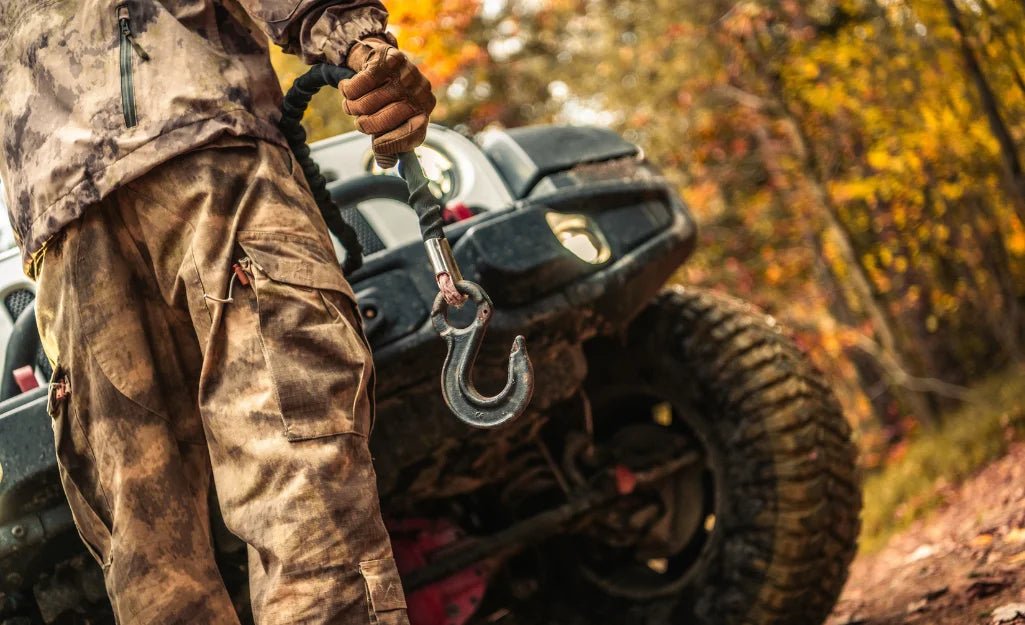
The Red Rock 4-Wheelers run trail leaders, mid-pack coordinators, and tail gunners on every EJS ride. Solid safety infrastructure. But your off road recovery gear is still your responsibility. A cheap recovery bag photographs well and fails the first time a rig actually needs it. Real Recovery Gear — straps rated to the weight you are pulling, shackles that will not deform, a block that redirects load without binding — that is what earns the permanent spot behind the seat.
Why Air Compressors Are Non-Negotiable Gear For Off Roading At Every 4x4 Trail
Air down before the trail, air up before the highway. Most basic ritual in off roading equipment. Skip the air-down and you fight for traction on every obstacle. Skip the air-up and you shred sidewalls on the drive home. A surprising number of people do one or both because they have no compressor mounted.
That is not a budget problem. It is a priority problem. A mounted Air Compressor eliminates the entire dilemma. The official Jeep Easter Jeep Safari page lists proper tire pressure management among their trail essentials, and there is good reason for that.
Air management is not optional gear for off roading. It is foundational.

Your Spring Vehicle Maintenance Checklist: What EJS Reminds Us To Fix Every Year
Tire Inflation, Winch Recovery Kit Inspection, And The Off Road Inspection Checklist That Prevents Trailered Rigs
Before your first trail day of the season, pull every inch of winch rope off the drum. All of it. Look for fraying, kinks, heat damage. A winch that jams under load is worse than no winch — it hands you confidence with zero function at the exact moment both matter. Then grab your deflator and gauges from your Tire and Inflation kit and verify accuracy. A gauge that reads 3 PSI off means your sidewall math is wrong on every obstacle all day. Overland Adventures publishes one of the better pre-trail and post-trail inspection checklists available — worth running through before every season opener.
Lights, Lines, And Fluids — The Off Roading Equipment Check Before Trail Season
Pop the brake fluid cap. Dark or cloudy means moisture contamination. Lower boiling point. Pedal fade on the first serious descent of the year. Five minutes and a flashlight. Run your hand along every brake line feeling for cracks, swelling, or rub marks. Then walk around the rig and check every light — turns, brake, reverse, and any trail Lighting and Visibility you have added. One dead reverse light during a night recovery is not minor. It is a safety gap that takes thirty seconds to prevent.
Water, Comms, And First Aid — The Off Road Self Rescue Basics EJS Vets Never Skip
This part has nothing to do with Jeep parts and accessories and everything to do with not being the cautionary tale someone tells at camp that night.
One gallon of water per person per day. Minimum. A first aid kit you have actually opened and checked this year — not the one from 2019 buried behind the rear seat. And communication that works where cell towers do not — CB, HAM, satellite messenger, anything — because service dies about two miles past the trailhead on most best beginner 4x4 trails in Moab. The people who skip this show up with one bottle of Gatorade for a six-hour day and no recovery strap. You know exactly who they are. Do not join them.

Final Thoughts — Why American Made Jeep Parts Matter More Than Brand Hype On Best Jeep Trails In Moab
Sixty years of Easter Jeep Safari boil down to something you can write on a napkin: structure first, recovery second, aesthetics last.
The rigs that make it home are not the ones with the longest mod list. They are the ones where every part was chosen in sequence, installed for a reason, and inspected before the season started.
We build parts at Mountain Offroad because we think about this stuff all the time. Steering box mounts, skid plates, motor mounts — designed in Colorado, machined from American steel, tested on the same terrain that breaks the factory parts we replace. But the real point of this post is not about what we sell. It is about the order in which you build, the discipline with which you maintain, and the honesty to look at your rig and ask whether it is actually ready — or just looks like it is.
Whether you are sorting through best Jeep aftermarket parts for a Wrangler, looking at Toyota 4runner off road accessories, or prepping a Gladiator for real off roading in Moab — the philosophy holds.
Build in order. Maintain on schedule.
See you on the trail.

Leave a comment
This site is protected by hCaptcha and the hCaptcha Privacy Policy and Terms of Service apply.