
Overview
Most of us have a pile of recovery gear somewhere in the rig that we bought in a weird order, half of it on sale, and we have never actually used most of it under pressure. No judgment — we have all been there. You see a deal on a strap kit, you grab it, toss it behind the rear seat, and feel responsible for about forty-eight hours.
Then the trail happens, and the thing you actually need is the thing you do not have.
This whole guide came out of that exact frustration. We wanted to build a four wheel drive recovery gear roadmap that makes sense — not a shopping list disguised as advice, but a genuine stage-by-stage plan where each piece earns its spot in the rig before you move on.
Table of Contents
Stage 1 handles the stuff that gets you out of eighty percent of situations without a winch.
Stage 2 adds the solo self-recovery tools for when there is no buddy rig behind you.
And Stage 3 is the one nobody talks about — tech that keeps you from getting stuck in the first place, which, honestly, is the best money you will spend.

Before You Buy Anything: The Four Wheel Drive Recovery Gear Basics Most Kits Leave Out
Why Your Vehicle's Weight Rating Decides Your 4x4 Recovery System Before Anything Else
This one is easy to overlook, but it saves a lot of headaches later. Your GVWR — the number on the door jamb sticker — is basically the ceiling for every recovery rating decision you make. A stock JL two-door is around 4,400 pounds. Throw on 35s, steel bumpers, a rack, and weekend camping gear, and suddenly you are in the 5,800–6,200 range. That gap changes what strap, shackle, and winch ratings actually make sense for your 4x4 recovery system.
Worth knowing before you buy anything, not after. Off-Road Xtreme has a straightforward article on vehicle weight ratings and towing capacity that walks through the math if you want to double-check yours.
Why Cheap Recovery Straps And Soft Shackles Hurt People — And What To Use Instead
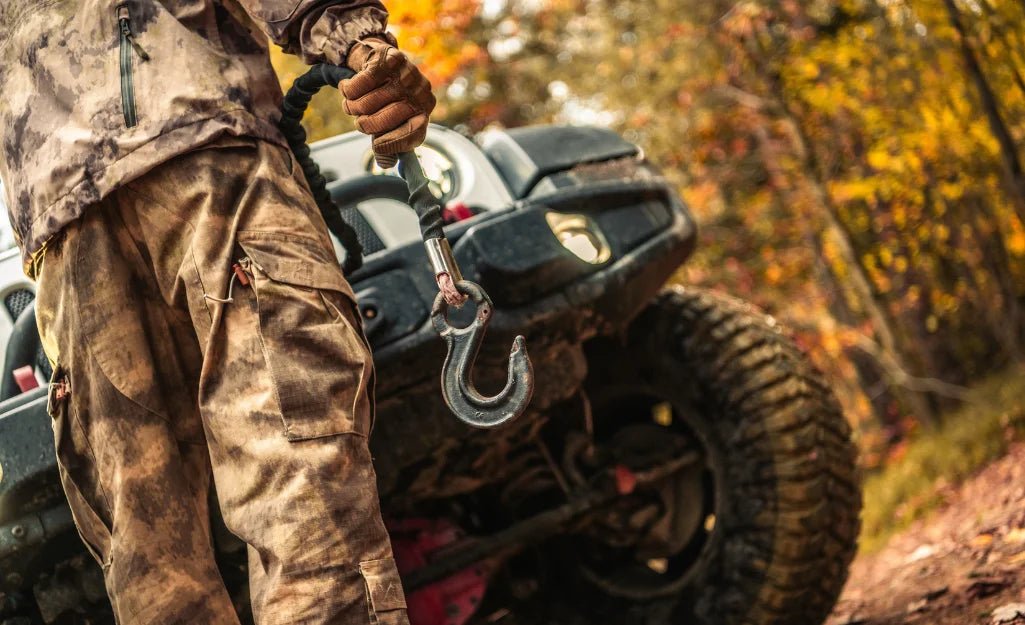
Here is the thing with bargain-bin straps — the failure mode is not always obvious. Sometimes a cheap strap just quietly stretches past its rated limit and dumps all the stored energy in one direction. A steel shackle at the end of that equation becomes a projectile. Soft shackles made from UHMWPE are a simple fix. Same working load limit as a steel D-ring, about a tenth of the weight, and way less dangerous if something goes sideways. Physics is on your side here — less mass means less energy on failure.
Mountain Offroad's Recovery Gear pairs soft and hard shackles with rated straps in one place. Saves you from playing mix-and-match across four Amazon listings and hoping the numbers work together.
First Aid And Fire Safety Belong In Every Overland Recovery Gear Setup
Nobody gets excited about a fire extinguisher. Fair enough. But a catalytic converter touching dry grass at 900 degrees does not care about your enthusiasm. The difference between a singed fender and a total loss on a trail with no fire department is about ten seconds of access time. Just worth having an ABC-rated extinguisher mounted where you can actually grab it. Not buried, not under the seat — mounted. That is all.
H3R Performance has a practical guide on fire extinguisher access when off-roading if you want to think through placement. Mountain Offroad's Fire Extinguisher Brackets are designed exactly for this — quick access without eating up cargo space. Part of any solid overland recovery gear setup.

Stage 1 – The Jeep Recovery Gear That Solves 80% Of Stuck Situations
Off Road Traction Boards: Your First Move When You're Stuck
Before you strap up to anything, before anyone even gets out of the buddy rig, just try the boring thing first. Off road traction boards get about zero respect because there is no drama involved. Dig a little, slide the board under the spinning tire, drive out, drink your coffee. That is it. And that works roughly eighty percent of the time on sand, mud, and snow.
The best recovery traction boards use reinforced nylon with aggressive nodules that actually bite into tread instead of just sitting there getting spit out. Mountain Offroad stocks the Ultimate Traction Recovery Board with Steel Plugs — handles rigs up to 4.5 tons, does not warp under repeated use, and takes up almost no room. Solid piece of Jeep recovery gear to start with.
TREAD Magazine has a good reference on essential off-road recovery gear and techniques if you want to see how boards fit into a bigger extraction sequence.
Kinetic Recovery Rope, Straps, And Winch Shackle Basics For Every Rig
Quick distinction that saves confusion: a tow strap is a static line for controlled pulls. A kinetic recovery rope stretches twenty to thirty percent under load, stores the energy, and uses the rebound to pop the stuck vehicle out. Totally different tool, totally different physics. The stretch does the work, and the shock load on both vehicles drops dramatically compared to a chain pull.
Match your winch shackle to the rope's break strength so the weakest link in the system is always the most predictable one. Soft shackles rated above the rope keep the failure point where you want it.
Our Deluxe Recovery Kit bundles eight items with three storage bags and a lifetime warranty — good starting point if you do not want to piece things together individually. The Shackles collection has standalone options if you already own a base kit and just need better hardware.
Air Management: Tire Deflator, Tire Pressure Gauge, And The Best Portable Tire Inflator To Get Home
Drop from 35 PSI to 18 on a 35-inch tire and you roughly double the contact patch. More rubber on the ground, more grip, less digging. It is genuinely the easiest performance upgrade out there — if you actually do it consistently.
A proper tire deflator makes the difference between doing it every time and skipping it because it is annoying. Deflate-Rite valves let you set a target pressure and walk away — all four tires hit the same PSI without a tire pressure gauge and a stopwatch routine. Mountain Offroad carries the Deflate-Rite Valves specifically for this.
The way back is the other half. A tire inflator is not optional — highway driving on trail pressures shreds sidewalls. The best portable tire inflator for trail use needs at least 2.5 CFM with sustained run time. The Pro Performance Digital Air Inflator/Deflator does both inflate and deflate in one unit.
For a permanent setup, check the Air Compressors and Mounts collection and the Tire Inflation lineup. The ARB air compressor platform is still one of the most reliable permanent-mount options out there — built for duty cycles that portables just cannot handle. Whether the best tire inflator for you is portable or mounted depends on how often you air down, and Mountain Offroad carries both paths.
Off-Road Xtreme has a helpful article on airing down that covers how to deflate a tire properly and the common mistakes most people make on their first few attempts.

Stage 2 – The Self-Recovery Upgrade With 4x4 Winch Systems
Choosing The Best Offroad Winch
This is where you stop needing other people. A winch turns a solo stuck situation into a twenty-minute project you handle yourself, which matters a lot when cell service ended three miles back.
Rule of thumb — your offroad winch should pull at least 1.5 times your gross weight. For a loaded Wrangler around 6,000 pounds, a 12v winch in the 10,000–12,000 range gives you breathing room for inclines and mud suction. Synthetic winch rope has mostly replaced steel cable because a Winch Rope made from UHMWPE drops instead of whipping on failure. A solid Winch Hook with a forged latch holds under angle loads, which matters way more on trail than in a parking lot demo.
Mountain Offroad's Winch Accessories collection has the best offroad winch options alongside rated 4x4 winch accessories — hooks, ropes, fairleads, everything for a complete 4x4 winch build without mixing brands.
TREAD Magazine has a solid piece on winching techniques covering straight-line pulls and anchor selection. And if you have never winched under load, E3 Offroad Association offers a free online course on safe recovery fundamentals — covers winch recovery gear protocol and double-line technique. Genuinely worth your time before the first solo pull.
Compact Hydraulic Jack, And The Winch And Pulley System That Multiplies Your Pull
A hydraulic jack does what a Hi-Lift does without the part where the Hi-Lift tries to rearrange your face. Not joking — ER data on Hi-Lift injuries is real. A compact hydraulic jack with a controlled descent valve just works cleaner on uneven ground. Mountain Offroad carries the CarbonPro Compact Hydraulic Jack with Mounting Clamps — a hydraulic jack for vehicle use that packs small and operates with one hand.
Pair that with a recovery ring and you have a winch and pulley system that doubles your effective pull while cutting line speed in half. Less load on the motor, less heat, longer duty cycle. The Carbon Offroad Monkey Fist 10T Recovery Ring handles it at a fraction of the weight of a steel snatch block.
Extended Range: Portable Fuel Containers and Offroad Power Stations For Remote Trails
Two things that bite you on remote runs: fuel range and electrical capacity. Rotopax nailed the fuel side with a modular system that mounts flat — rotopax fuel cans and rotopax gas can sizes from one to three gallons, with a rotopax mount that stays put on rough terrain. Mountain Offroad's Fuel Storage collection carries the full portable fuel containers and water storage container lineup.
Electrical is where things have changed. Running a winch, charging a fridge, powering a tire inflator, keeping comms alive on a multi-day run — that is more than a dual-battery setup can handle gracefully. A portable power station or offroad power station with lithium-iron-phosphate cells gives clean, predictable capacity. The best solar generator setups pair a base with a folding panel — charge by day, run by night. A full portable solar power generator kit makes extended backcountry trips realistic.
Mountain Offroad's Battery Systems & Accessories and Portable Power Accessories collections have options from compact overnighters to full expedition setups.

Stage 3 – The Stuff That Keeps You From Getting Stuck With ARB Air Compressor And Throttle Controller Tech
Throttle Controller For Precise Modulation: Why Prevention Beats Recovery
What if the smartest recovery investment is the one that keeps you from needing recovery?
A throttle controller adjusts the pedal-to-throttle response curve on drive-by-wire rigs. On a highway, the stock mapping feels fine. On a rocky crawl or a wet clay descent, that same mapping gives you too much input too fast, and that is how a manageable line turns into a stuck situation. A few percent of throttle difference is all it takes.
Mountain Offroad carries Throttle Controllers and is an authorized Pedal Commander dealer — the Pedal Commander Partner Brand page has model-specific fitment info.
Moore Expo has a great piece on mastering brake and throttle modulation for overland adventures if you want the longer technical read on why precision prevents the problems straps fix after the fact.
Trail Lighting And Vision X Offroad: See The Obstacle Before It Stops You
Simple logic: if you cannot see the line, you cannot drive it. And if you cannot drive it, you are reaching for winch recovery gear instead of rolling into camp.
Vision x Offroad lighting separates useful trail illumination from the blinding wall of light most cheap LED bars produce. Wide pattern shows what is beside you. Spot pattern shows what is two hundred feet ahead. Together, they tell you where the holes are before your tire finds them.
Mountain Offroad's Lighting & Visibility collection carries the full Vision x Offroad range with bracket kits for clean mounting.

Final Thoughts: Why Access Speed Matters More Than Gear Volume
There is an old trailhead rule: gear you cannot reach in sixty seconds is gear you do not have. A kit buried under camping chairs and coolers is just a storage locker with ambition.
MOLLE panels fix that. The military figured this out decades ago — modular, wall-mounted organization beats stacking and digging every time. Mountain Offroad's MOLLE Panels collection lets you mount straps, shackles, and tools against the sidewall where you can see them, grab them, and go. The Trail Accessories collection adds bags and mounts that keep things from turning into a yard sale after the first washboard.
One last thing — and this is easy to forget — inspect your stuff. Soft shackles have a service life. Straps develop micro-tears. Synthetic winch rope degrades under UV. Ladies Offroad Network has a handy reference on recovery gear labels — WLL ratings, manufacturing dates, retirement dates, all of it. Worth a quick read so you know when a piece of gear crosses from reliable to risky.
Build in stages. Buy rated, not cheap. Know your rig's weight before you buy the first strap. And mount everything where you can grab it fast, because the trail is not going to wait while you dig through the wrong bag.


Leave a comment
This site is protected by hCaptcha and the hCaptcha Privacy Policy and Terms of Service apply.