Overview
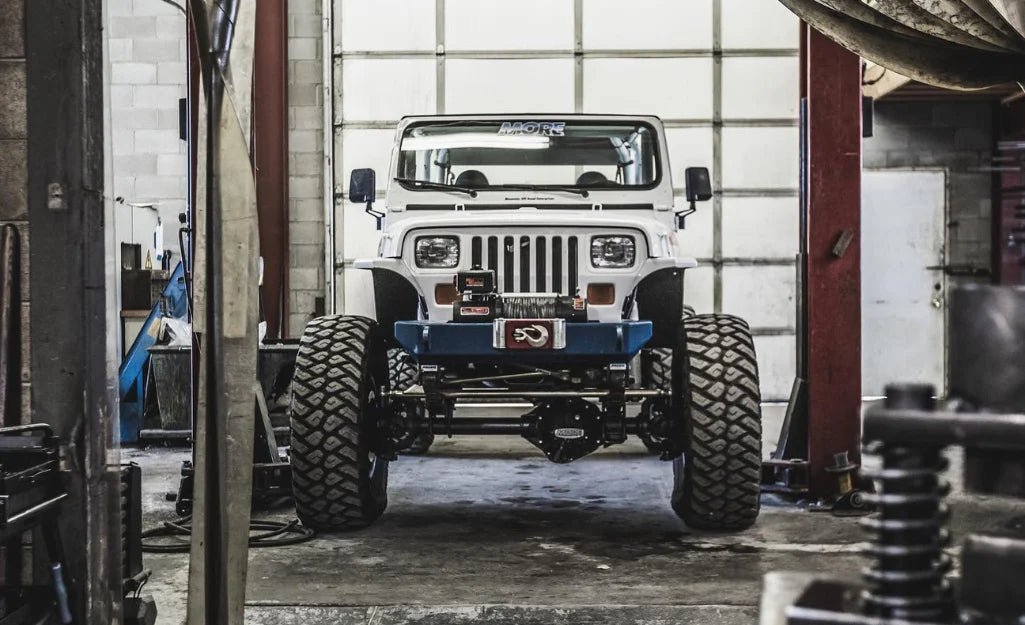
Somebody just sent you a listing for a square-headlight Jeep. Is that Jeep YJ good first Jeep material, or a very loud way to empty a savings account?
Honest answer from people who build parts for these Jeeps in Colorado: it can be either. The YJ is kind to owners who do things in the right order and brutal to the ones who start with 35-inch tires... This guide gives you that order in plain English.
Table of Contents
- Is The Square-Headlight Wrangler Really Your Jeep?
- Jeep YJ Or TJ? Who The YJ Suits And What Your Money Actually Buys
- Jeep YJ Years To Avoid And The Jeep YJ Rust Spots That Should Kill The Deal
- The Build Order: YJ Build Ideas Worth Doing First
- Knowing When To Stop: Protect Your Jeep YJ Value
- What Jeep YJ Parts Really Fail
- The Tire-Size Rule For A Jeep YJ Lift That Won't Break The Bank

Part 1 – Jeep YJ Buyers Guide: Is The Square-Headlight Wrangler Really Your Jeep?
Jeep YJ Or TJ? Who The YJ Suits And What Your Money Actually Buys
The YJ replaced the CJ-7 for 1987, kept leaf springs at all four corners, and traded round headlights for rectangles. Jeep says 630,000 sold through 1995.
So who wins the Jeep YJ vs TJ fight? The YJ suits three kinds of people. The learner, because nothing on a YJ hides behind a computer. The budget builder, who wants solid axles front and rear without TJ prices. And the driver who won't cry when a branch scratches the door.
Who should walk away? Highway commuters will be happier on the TJ's coil springs. If nobody around you touches a wrench, an old Jeep will punish that. And no YJ has airbags.
Your money buys two solid axles, a simple drivetrain, and on 1991 to 1995 trucks, the fuel-injected 4.0L inline-six... Comparing Jeep YJ 4.0 vs 4.2? The older 4.2 pulls fine down low, but its carburetor is fussy. The 4.0 makes around 180 horsepower, and Jeep YJ 4.0 reliability is campfire legend, with many passing 200,000 miles on basic care.
Myth vs. Truth: "A Jeep this old can't be trusted." In Jeep's announcement of the five-millionth Wrangler, the brand's North America chief said more than 80% of Wranglers sold since 1986 are still on the road.
Back in 2019, Hagerty's YJ profile listed a good-condition YJ at a median $8,100, so check current local listings before you haggle.
Tired rubber motor mounts are typical. The Bomb Proof ones in our Motor Mounts collection are American made Jeep parts that bolt into the stock frame. For fender protection and a winch mount, a Rock Proof Jeep YJ front bumper from the Bumpers collection is cut from 3/16" steel plate.
Jeep YJ Years To Avoid And The Jeep YJ Rust Spots That Should Kill The Deal
Knowing what to look for when buying a Jeep YJ starts with the calendar.
The 1987 trucks got the NP207 transfer case (the gearbox that powers the front axle), which owners rate well below the NP231 used from 1988 on… Trucks from 1987 to 1989 could also carry the Peugeot BA-10/5 five-speed, a transmission with a rough reputation. Before 1991, you get a carburetor buried under emissions hoses. That's why the best year Jeep YJ range is usually 1991 to 1995, ideally a 4.0 with a five-speed manual.
But metal matters more than the year. Engines are easy to fix. Rust kills YJs.
Here's the driveway test. Grab a flashlight and a screwdriver and tap the floor pans, the body mounts, the frame around the steering box, and the rear frame near the springs. Solid metal rings. Rot crunches. A Wrangler Forum member warned that a frame can look fine outside while the inside is toast, so if the screwdriver goes through, walk away.
Then test 4WD on dirt. YJs use a vacuum-operated front axle disconnect, and when its lines crack, the 4WD light comes on while the front wheels do nothing. Often it's a cheap line, sometimes worn parts inside, so get it checked before you agree on a price.
Dry-rotted body mounts are cheap Jeep YJ replacement parts that tighten the tub. The polyurethane pieces in our Body Mounts collection won't squeak, and you'll reuse the factory steel sleeves.

Part 2 – The Build Order: YJ Build Ideas Worth Doing First
Everyone wants to start with a lift. Don't. Safety first, comfort second, strength third.
#1 – Make It Steer Straight Before You Lift It: Is A YJ Steering Brace Necessary?
The YJ steering box bolts to the driver-side frame rail. Every turn with bigger tires yanks on that rail, and over time the frame around it can crack. Then the box moves, the Jeep wanders, and you get Jeep YJ bump steer or Jeep YJ death wobble, the violent shake that only stops when you slow way down.
Try this 30-second check. Set the brake, keep hands clear of moving parts, and have a helper rock the steering wheel a few inches each way with the engine running while you watch. The steering box shouldn't shift on the frame. The steering rods and both ends of the Jeep YJ track bar, the bar that keeps the front axle centered, should move instantly with no clunk. Any lag is where wobble starts.
On stock tires, many owners never have trouble. Add 33s, a locker (a part that forces both wheels on an axle to turn together), or regular trail time, and a YJ steering brace becomes cheap insurance. Our Steering Brace for Jeep Wrangler YJ (1987-95) bolts on and ties the box to the passenger frame rail so both rails share the load... The stronger Steering Box Mount for Jeep Wrangler YJ (1987-95) sits 1" forward so the steering rods stop hitting each other. Together, that's a real Jeep YJ steering box brace setup.
Myth vs. Truth: "A steering stabilizer fixes death wobble." It only hides the looseness behind it. Our death wobble guide walks through the real fix.
#2 – Jeep YJ Leaf Springs, Done Right: Is A YJ Shackle Reversal Worth It?
Tall arched lift springs give easy height and a sore back. Flatter springs and fresh bushings ride softer. Fix those, and Jeep YJ ride quality gets better than most owners believe. Leaf springs don't ride rough. Bad leaf spring setups do.
A shackle is the swinging link at one end of each spring. Greasable shackles let you pump grease into that pivot so it moves instead of binding. The ones in our Shackles collection are 3/8" laser cut steel with drilled bolts that feed grease into polyurethane bushings.
Now the big debate. Stock front shackles sit at the front of the springs. Hit a bump, the axle wants to move back, and the spring fights it. A Jeep YJ shackle reversal moves the shackles to the rear, so the axle moves with the hit. The front softens, and bump steer usually drops.
The shackle reversal pros and cons nobody prints on the box? The nose dives more under hard braking. Tires can tuck into the back of the fenders. And the front driveshaft needs a longer slip section, or it can bottom out and hurt the transfer case. One JeepForum owner pulled his off the next day. Off-Road.com's breakdown of shackle reversal covers both sides.
Worth it for fast dirt roads or daily driving, less so for slow crawling. Our Shackle Reversal System bolts on with an adjustable hanger and greasable pivot bolts. No welding, though you will drill a few holes in the frame.

#3 – YJ SOA Vs SUA: When Spring-Over Pays Off And How To Beat YJ Axle Wrap
SUA means spring under axle, the factory way. SOA flips the springs on top. A YJ spring over axle setup gives a big lift without tall springs, and with flat springs, a Jeep that flexes like a gymnast.
A proper spring over axle conversion means welding new spring perches onto the axles, driveshaft work for steeper angles, and usually YJ high steer, which moves the steering rods up above the springs so they don't fight the new geometry. One JeepForum builder warned that a sloppy spring-over endangers everyone on the highway. Our Spring Over Kits use 1/4" plate steel perches, so your Jeep YJ spring over foundation won't be the weak link.
Then there's axle wrap. Stomp the gas and the rear axle tries to rotate, twisting the springs into an S. The Jeep hops, and U-joints start breaking. Our weld-on Traction Bar for Rear Axle mounts to the transfer case crossmember and turns that twist into up-and-down motion without limiting flex, the traction bar YJ fix when wrap won't quit.
#4 – Is The YJ Dana 35 Really That Bad? The YJ Ford 8.8 Swap That Fixes It
To be fair to the Dana 35, the YJ's stock rear axle, one Wrangler Forum owner reported 225,000 miles on 31s. Not junk, just small.
Calling the Dana 35 weak isn't forum drama, though. Its axle shafts are thin, its ring gear (the big gear inside) is just 7.5", and small C-clips hold the shafts in, so a broken shaft can let the wheel slide out. Add big tires and hard throttle, and something gives.
Put Dana 35 vs Ford 8.8 side by side: the 8.8 brings an 8.8" ring gear, thicker 31-spline shafts from the right donor, rear disc brakes, and the same 5x4.5 wheel bolt pattern, so your wheels still fit.
Myth vs. Truth: "The 8.8 is way wider and needs major fab." Depending on who's measuring, it's within about half an inch per side of the Dana 35. Wheels that sit a bit farther out cover the difference.
Here's the cheat sheet for what year Explorer 8.8 for YJ swaps. A 1995 to 2001 Explorer or Mercury Mountaineer has the disc brakes and 31-spline shafts. Explorer Sport Tracs built between August 2002 and June 2005 share the same axle. Most came with 3.73 gears, many with limited slip. Read the axle tag before paying, and match your front axle ratio, or 4WD will fight itself. The Ranger Station's 8.8 history and specs page decodes those tags.
Once you know which Ford Explorer 8.8 for YJ builds need, our Ford 8.8 Kit covers the weld-on spring mounts, shock mounts, U-bolts, and plates, plus the yoke adapter and emergency brake cables in the same collection. This swap needs welding, and your ABS gets disconnected. For the full Ford 8.8 swap Jeep YJ walkthrough, read our complete Ford 8.8 axle swap guide.

Part 3 – Knowing When To Stop: Protect Your Jeep YJ Value
Nobody plans to spend more on a YJ than it's worth. It happens one "while I'm in there" at a time, and buyers later pay for clean metal and finished work, not for part count.
Snapped Shafts, Cracked Frames, And A $231 Swap: What Jeep YJ Parts Really Fail
In a JeepForum thread titled "Is a dana 35 really that bad?", one owner ran an open Dana 35 on 31s for years with zero trouble. Then he lifted the Jeep, went to 35s, and added a used ARB locker to stretch the axle one more year. He snapped a shaft on his first trip out, and the shock took the locker with it. Another YJ owner on the same forum broke his Dana 35 on 35s in under two months, on the street.
Steering threads split too. Some say a ball joint dies long before a steering box tears loose. Others have watched YJs on 33s rip the box off the frame, and owners in salty states say the metal around the box rusts and cracks first.
And the $231 swap? A JeepForum member got tired of hearing the 8.8 swap costs $750 to $1,000. He paid $413 for the axle and equipment plus $68 for the hand brake setup, then sold his old Dana 35 for $250. Total: $231 for a limited-slip axle with the 4.10 gears he'd need later for 33s. That's a best case for someone who welds. The lesson still works for anyone: sell the old axle, buy the gears you'll need anyway, and Jeep YJ aftermarket parts stop being a money drain.
The Tire-Size Rule For A Jeep YJ Lift That Won't Break The Bank
Pick your tire size first. Your budget follows.
On 31s, healthy stock axles are fine and you need little or no lift. Spend on steering fixes, bushings, shackles, and shocks.
On 33s, YJ owners usually run about 2.5" of suspension lift plus a 1" body lift, or roughly 4" of suspension lift. Add the steering brace and regear both axles, meaning new gears with a higher ratio number, which pulls harder but spins the engine faster on the highway. For a 4.0 with a manual, forum consensus lands on 4.56, with 4.10 as the milder choice for highway driving or the three-speed automatic. Four-cylinders need deeper gears. Forum-posted shop quotes for both axles often run $1,400 to well over $2,500. An open Dana 35 can still live here.
Myth vs. Truth: "Add a locker and any axle is trail-ready." Forum veterans agree: an open Dana 35 on 33s or smaller is okay, a locked one is asking to break.
On 35s, expect around 4" of suspension lift with a body lift or trimmed fenders. The 8.8, deeper gears (4.88 is the common pick with a 4.0), a slip yoke eliminator for driveline angles, and serious steering work stop being optional. The front Dana 30 feels it too, so many owners add stronger front shafts. One YJ veteran's built-up 8.8 did fine until he passed 35s, then kept bending shafts on 37 to 39-inch tires.
A clean YJ on 33s sells. A half-finished spring-over sells cheap. Build for how you actually drive, and your Jeep YJ custom parts keep their worth.

Final Thoughts
The YJ isn't the softest Wrangler. It's the honest one. So, one more time: Buy rust-free. Make it steer straight. Sort the springs. Pick your tire size and gear for it. Then give it a rear axle that can take a hit, and go enjoy it.
Browsing Jeep YJ parts for sale for your first weekend of wrenching? Start at the top of that list… Your wallet will thank you, and so will everyone riding along.


Leave a comment
This site is protected by hCaptcha and the hCaptcha Privacy Policy and Terms of Service apply.